


Preview
Identifier
20031573
Description
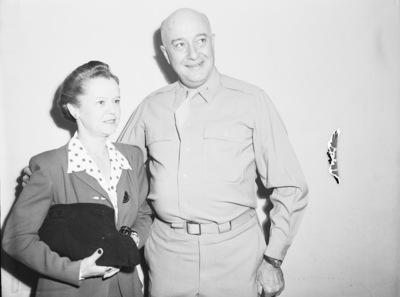
Colonel Nat S. Perrine and wife of Fort Worth.A middle-aged couple standing near a blank wall. She is wearing a suit jacket and skirt with huge buttons over a light polkadot blouse, and clutching a dark corduroy handbag. She is wearing earrings. He is wearing a khaki uniform shirt and trousers with a matching tie tucked into his shirt front. There are stars pinned to his collar tabs. Even his belt appears to be the same neutral tone of his shirt and trousers. He is wearing a wristwatch. Clipping:"GI Jose's in SchoolBy Charles K. Boatner.Back in the early days of the warâ€â€Rommel was running hog-wild in Africa and all indications were that he'd bring his victory-intoxicated Nazis across to Brazil and then up into the United States.The Army grabbed up Col. Nat S. Perrine of Fort Worth, a regimental commander of the 36th Division, pinned stars on his shoulders and hustled him to Puerto Rico as commanded of a rugged, free-swinging, fast-moving fighting team which was the U. S. insurance on keeping a strong American hold on the island.The insurance never was used. The Rommel machine was stopped cold and the picture of Puerto Rico as a strategic military outpost faded.The U. S. Army Mobile Force was dissolved and General Perrine became commander of the Army Replacement depot at the island.In his words, the robust civilian-life rancher traded his pistol for a primer.THE PUERTO RICAN WAY.Visiting his wife here last week while en route from Washington back to his command, General Perrine outlined fighting the war the Puerto Rican way.The biggest problem he has had and the only one he's proudest of solving was the War Department order to teach the Spanish-speaking island natives to read and write English during the 12-week basic training in military fundamentals.The order came out after several hundred replacements were sent to the European continent. The ETO [European Theater of Operations] found itself with a huge group of Spanish-speaking (and only Spanish) soldiers and with no immediately feasible place to use them.General Perrine had no instructors, no English textbooks, no classrooms and no plan for teaching the Puerto Ricans how to speak and write English in 12 weeks already crowded up with a military training program.However, he did have an inkling of an idea.He had observed that, like at all other concentrations of soldiers, the towns surrounding the Puerto Rican military installations had attracted many women of questionable virtue, and that these Spanish-speaking women had quickly picked up English enough to put their conversations across to men from the states.NONE WITH EXPERIENCE.The general reasoned that if the women could pick up the language easily the men could, too, so he installed what he now calls "simultaneous eye and war training.'The instructors were picked from the depot cadre. Some were ex-truck drivers, some clerks, and one was an ex-whisky salesman. Some were former students but none was a experience teacher. (They were from all parts of the United States and General Perrine swears that today he can talk to a Puerto Rican soldier and tell by the soldier's accent whom he had as an instructor.)The tailend of 125 barracks were turned into that number of classrooms, and the classes startedâ€â€all conversation, all writing was in English. Spanish was taboo.Every action he made in recitation, the student soldier described. When he stood up to answer a question, he stated: 'I stand up.' When he raised his hand to answer a question, he stated: 'I raise my hand.'In all, General Perrine says, the school used 57,000 training aids, ranging in size from a two-ton truck to a needle. The Army couldn't gather up anything like enough primers for illiterate soldiers, termed 'Private Pete,' on the continent, so it furnished General Perrine a single copy.Illustrations in it were all strange insofar as the Puerto Rican was concerned. The picture of 'mother' was of a typical middle-aged American woman, and simply didn't fit the Puerto Rican idea. The picture of 'home' was a typical American bungalow. That didn't tie in with the Puerto Rican abode at all.CHANGED THE PICTURES.General Perrine hunted through his command and came up with four artists, one a Walt-Disney-trained man, who corrected the illustrations, and an engineer unit used its facilities to supply the thousands of needed texts. The engineers, using a multilith [page printing system] process, stayed one page ahead of the rapidly learning students, General Perrine recalled.When the first 12-week period was ended, the training was a success, and the replacements went to the theaters of operations after that were able to understand their commands, verbal or written, and to make themselves readily understood.Since the program started, it has constantly improved. The army supplied trained teachers from the States to replace the 'volunteers,' but General Perrine still is using a few of those first instructors as classroom observers and 'suggestion' men. From them come many of the ideas for improving the training.HE WAS GRATEFUL.The story of the school isn't complete, General Perrine says., without the tale of the soldier who refused to take his first paycheck.'I am clothed. I am fed. I am learn to wash my teeth. I now speak English. You not pay me, I pay you,' the soldier said.'We discharged him . . . crazy.' General Perrine chuckled. 'He really was.' "Stamped Star-Telegram Morn. Apr. 22, 1945
Archival Date
1945-04-12
Collection Name
Fort Worth Star-Telegram Collection
Collection Number
AR406-6-296
Original Format
Negatives, Black & White
File Format
JPG
Rights
Rights held by The University of Texas at Arlington Libraries, Special Collections. Any use of content downloaded or printed from this page is limited to non-commercial personal or educational use, including fair use as directed by U.S. copyright laws. For more information or for reproduction requests, please contact UTA Special Collections by emailing [email protected].
License

This work is licensed under a Creative Commons Attribution-NonCommercial 4.0 International License
Subjects
Teachers; Perrine, Nat S.; Perrine, Nat S. (Mrs.); Perrine, Nat S. (Col.); Puerto Rico; Military outpost; English language; Spanish language
Subjects
Teachers; Perrine, Nat S.; Perrine, Nat S. (Mrs.); Perrine, Nat S. (Col.); Puerto Rico; Military outpost; English language; Spanish language