


Preview
Identifier
20031536
Description
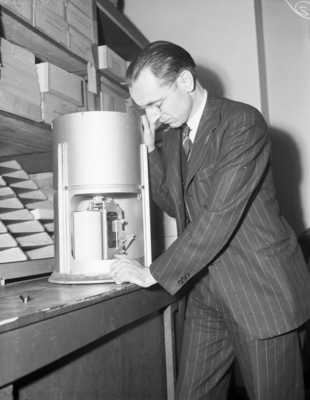
Henry Rockwood, assistant to Erle L. Hardy, head of the Fourth Region, U. S. Weather Bureau. With an automatic rain gauge.A man in a dark pinstriped single-breasted three-piece suit with a light shirt, a dark diagonally striped tie, a wedding ring, and eyeglasses. He is standing next to the rain gauge in a room that appears to hold office supplies. There is a wingnut on the counter to the left of the shiny metal gauge. A very long article was illustrated by three photos. This article is attached to each photo for context and reference. Clipping: "They Go Where Weather Is By Phil W. Edwards. Whether you are building a dam or bridge, planning to fly a plane or sail a boat in the Gulf, plant cotton or fight a forest fire, or just go fishing, you're bound to benefit directly or indirectly by an inclusive job supervised on the fifth floor of the United States Courthouse by hustling, husky, quick-to-smile Erle L. Hardy. That job is operating administrative headquarters of the Fourth Region, United States Weather Bureau, including Texas, Louisiana, New Mexico, Arkansas and Oklahoma, and Hardy, as regional director, gets the job done with the aid of R. C. Grubb, executive assistant; Henry Rockwood, regional engineer, and a staff of 32 men and women. There is a lot more to the job than assembling data on temperature and rainfall, as was demonstrated when the United States became a nation at war and activities of the various federal weather agencies, playing such a vital part in the picture, were clothed in secrecy. WORK WITH CAA [Civil Aeronautics Administration].Of especial importance was the weather information to a Nation preparing itself for a war in the air, and though most restrictions on publication of data now how been removed, there was a time when that same information might have been of value to the enemy. So closely is hardy's region co-ordinated with aviation that the Fourth Civil Aeronautics Administration Region, which also headquarters here, covers the same territory except that New Orleans is in the weather area and is not covered from here by the CAA. It is even the responsibility of the weather bureau regional office to give the meteorological instruction to CAA air traffic control observers who are trained in the Majestic Building. For many years the administration of the United States Weather Bureau was all handled from Washington, but improvements and modernization of the service indicated that decentralization was needed. 'There wasn't any question but that if you were going to administer the weather service down in this region then you'd better be down here in that weather where you could watch it,' Hardy says. THE NEW TREND. So, in September, 1939, Rockwood came here to establish a regional hydrological office, and the district meteorological office was moved to Municipal Airport. 'That was another trend in modern weather analysis,' Hardy said. 'A weather observer ought to be out where he can get up and scan the skies, study the clouds, and actually see the weather.'In September, 1941, Fort Worth became the regional weather bureau headquarters, and since then Hardy and his staff have directed services over the five States which include:General district forecasting; cold wave and other special warnings; state forecasts; airways forecasts; river and flood warnings; coastal hurricane warnings from New Orleans to Brownsville; climatological service; fruit frost service in the Rio Grande Valley, and regular service to agricultural interests. 1,000 RAIN GAUGES In New Mexico, in co-operation with the Forestry Service, there is a special report warning of 'dry' danger, and if a forest fire occurs there are regular reports on wind direction, to assist in fighting the blaze. And in mountainous areas special bulletins are issued covering amount of snow and moisture content, as well as predictions for operators of dams and irrigation projects. The hydrologic service maintains about 1,000 rain gauges throughout the region, half of them recording automatically and continuously, to keep track of precipitation at all points, every minute of the day and night. This information aids engineers, including those of the Army, in construction of dams, bridges, highways, and also furnishes valuable information to those engaged in agriculture and the cattle industry. 'You'll find about every possible type of weather somewhere in this region,' Hardy said, 'and to keep track of it all we have over these five States, more than 1,200 reporting stations, including 1,137 non-paid, co-operative observers. 'And then there is the most modern phase of this weather gameâ€â€radiosonde. Time was not many years ago when weather bureaus at certain locations contracted with private pilots to spiral up about 7,000 feet above a bureau location, carrying weather instruments with them. It took about four hours for the plane to reach it's proper altitude and descend, and not until it came down were the vital records available. 'The time element was bad, but the real reason the plane service was abandoned was because the mortality rate of pilots was too high,' Hardy explained. 'When the weather was bad for flying was just when we wanted them to go up, and they got a bonus. 'But a lot of them got daisies instead of a bonus. AND NOWâ€â€RADIOSONDE. Then came radiosonde. With it, an automatic broadcasting set, so compact that it fits in a container little larger than a cigar box and weighs only three pounds, is attached to a 320-gram rubber balloon about four feet in diameter. Inflated to about 10 feet with helium, the free balloon carries the radio set up into the stratosphere, maintaining a continuous and instantaneous report to the ground station on temperature, humidity and barometric pressure.By the time the balloon reaches its peak ceiling of about 65,000 feet in the rarified atmosphere it has expanded to about 24 feet, and pretty soon it bursts. Then a silk parachute opens up and the radio instrument, according to regulations, settles gently back to earth. The weather service pays $1 for return of the instrument, which may be mailed at any post office, and recovery of them runs about 75 per cent. Sometimes the equipment doesn't perform according to regulations, though. There was one such occasions near Gainesville recently. A farmer was plowing in a field, when an aluminum painted box swished past his head and landed with a thump in front of him. The farmer glanced up and saw a plane droning overhead. He grabbed the little box, went to town and phoned the FBI.It was just a case of the parachute failing to perform according to regulations. USE LOTS OF RUBBER There are nine radiosonde stations in the region, and also 18 pilot balloon stations where smaller rubber balloons are released four times daily to indicated wind velocity and direction at all levels. In fact, the weather bureau region, as well as similar regional services in this country and Alaska, use lots of rubber balloons, and they aren't made of synthetic rubber. But the shortage hasn't hurt much because the vital nature of the reports supplied by the bureaus assures them a high priority.There is another phase connected with the region supervised by Hardy. It maintains a co-operative weather report arrangement with Mexico and 'points south,' just how far south remains one of the military restrictions still in force.â€â€Star-Telegram Photos." Stamped: Star-Telegram Morn. Nov 11, 1943
Archival Date
1943-11-04
Collection Name
Fort Worth Star-Telegram Collection
Collection Number
AR406-6-296
Original Format
Negatives, Black & White
File Format
JPG
Rights
Rights held by The University of Texas at Arlington Libraries, Special Collections. Any use of content downloaded or printed from this page is limited to non-commercial personal or educational use, including fair use as directed by U.S. copyright laws. For more information or for reproduction requests, please contact UTA Special Collections by emailing [email protected].
License

This work is licensed under a Creative Commons Attribution-NonCommercial 4.0 International License
Subjects
Suits (Clothing),Office supplies; Rockwood, Henry; U.S. Weather Bureau; Wartime weather reporting; Classified defense information; Weather reporting equipment; Office Supplies
Subjects
Suits (Clothing),Office supplies; Rockwood, Henry; U.S. Weather Bureau; Wartime weather reporting; Classified defense information; Weather reporting equipment; Office Supplies