


Preview
Identifier
20028816
Description
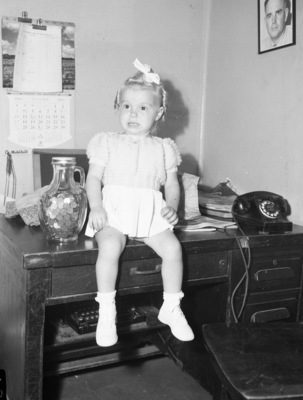
Sharon Sue Wilkerson, 2 yrs old daughter of Mr. and Mrs. Wilkerson A small girl in a light outfit of a knitted top and a light skirt is perched on the edge of an office desk. She has a bow in her hair and is wearing light socks and shoes. A lidded pitcher full of pennies is on her right and a Bakelite dial telephone is sitting to her left. Behind her are books and papers and beneath her feet tucked into the desk knee hole is a portable typewriter. A chair seat is visible in the right of the front of the photo, a man's photograph is on the wall in the upper right of the photo, and on the upper left is a 1943 calendar open to October. Clipping: "Two Year's Gains Sharon Sue Wilkerson, who will be 2 years old Nov. 7, is shown with a jar of 2400 pennies with which she is going to buy a war bond. Her parents, Mr. And Mrs. Reese Wilkerson of 604 Negley in Liberator Village, have been saving pennies for Sharon Sue since she was born." NOTE: This area is gone, absorbed into the city of White Settlement and gone by the mid-1950s. From Wikipedia: "Liberator Village" The Liberator Village was the government housing area for employees of the Consolidated Aircraft Corporation aircraft manufacturing plant which was constructed after 18 April 1942[1] next to the Army Air Force (AAF) Base Tarrant Field Airdrome, and an AAF aircraft plant NO. 4 was built just west of Fort Worth, Texas along the south side of Lake Worth. The Consolidated Vultee Bomber Plant workers would build the B-24 "Liberator" heavy bomber. Later, they would build the B-32 Dominator bomber that made it to the war for only a short time. The plant begun production less than a year later while much of its workforce was accommodated in the 1500 prefabricated dwelling units located around the south gate of the bomber plant which housed men and women that built the B-24 bomber near Fort Worth, Texas during World War II. The war had caused a shortage of housing in the area, therefore, the government decided to build a complex within walking distance to the plant.[4] It would be named Liberator Village after the name of the B-24 bomber. . . . .The village was operated by the Federal Public Housing Authority, later to be called the Fort Worth Housing Authority (FWHA). The FWHA was directed by Mr. Lealand Hunter. . . .The apartments were constructed in four stages at a cost of three and a half million dollars giving six thousand people from all over the United States a place to live near the new plant. . . . . In May 1949 the Village was inundated by a flood, but largely escaped damage with a small area north of the Village washed out by Farmers Creek. A few trailer houses were damaged, and one boy was killed. The Village became a part of the White Settlement in 1954 and finally closed in 1955. It is now a suburb of Fort Worth famous for its longest factory building in the World operated by Lockheed Martin, and its proximity to the Fort Worth Naval Air Station. https://en.wikipedia.org/wiki/Liberator_village
Archival Date
1945-10-26
Collection Name
Fort Worth Star-Telegram Collection
Collection Number
AR406-6-293
Original Format
Negatives, Black & White
File Format
JPG
Rights
Rights held by The University of Texas at Arlington Libraries, Special Collections. Any use of content downloaded or printed from this page is limited to non-commercial personal or educational use, including fair use as directed by U.S. copyright laws. For more information or for reproduction requests, please contact UTA Special Collections by emailing [email protected].
License

This work is licensed under a Creative Commons Attribution-NonCommercial 4.0 International License
Subjects
Wilkerson, Sharon Sue; Wilkerson, Reese (Mr.); Wilkerson, Reese (Mrs.); Liberator Village; War bonds & funds; Patriotism; Telephones; Desks; Calendars
Subjects
Wilkerson, Sharon Sue; Wilkerson, Reese (Mr.); Wilkerson, Reese (Mrs.); Liberator Village; War bonds & funds; Patriotism; Telephones; Desks; Calendars