


Preview
Identifier
20031604
Description
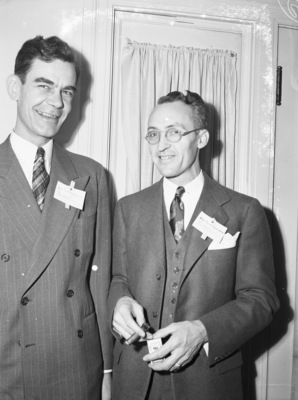
Left to right, H. F. Keisker of Saint Louis, Red Cross Midwestern area manager, Verne Moore.Two men in dark suits standing next to a curtained door, at least one of them is smoking. Keisker is in a double-breasted pin-striped suit with a light shirt and a diagonal plaid tie. Moore is in a single-breasted three-piece suit with a light shirt, dark patterned tie, and a handkerchief poking out of his breast pocket. He is wearing eyeglasses, a signet ring, and holding a cigar and box of matches. Both men have a conference ID tag that says "War Fund Conference" on their lapels.Clipping: "Red Cross Having Trouble Getting Aid to Prisoners of Jap[anise], Official AssertsThe American Red Cross, described as the 'largest hotel and restaurant operator in the world,' has more than 3,000 representatives overseas manning 484 clubs from Iceland to Australia and is prepared to send 60,000 packages a year to war prisoners.This report was made Friday by H. F. Keisker of St. Louis, Red Cross Midwestern area manager, to a war fund conference in Hotel Texas attended by chapter representatives from Texas, Oklahoma, Kansas and Missouri.Getting packages to Americans in Japanese prison camps has not been very successful, Keisker said, 'but when the way is opened we will get them through.'He said Japan agreed recently to accept packages sent to Vladivostok and Russia agreed to furnish storage space.'Fifteen thousand tons were sent monthly for two months and are still stored in Russia,' Keisker said. 'Russia has said they can not accept more shipments because of a lack of storage space.'He said the Red Cross has been able to put funds in the hands of representatives in Japanese-held areas to buy available supplies.Five centers are turning out one package a week for each prisoner, he said, and parcels routed to Germany via Marseille and Geneva have 'gone through without a single divers.'Captives are provided with a medicine kit, bathrobe, house slippers and toilet articles.The overseas program, he said, was planned in 1935 with advice of the Army and Navy.In England, 80 clubs have been established with a bed capacity of 15,000 and the Army wants this increased to 40,000.Charges are 30 cents for a room and 20 cents for foodâ€â€all a soldier wants.'Aerial Clubs' have been created for the Air Forces to provide a snack bar and recreational facilities. Ten cents is charged for all the drinks and sandwiches desired. Traveling 'clubmobiles' visit other centers, and 'rest homes' for nerve-shattered fliers have been established. 'Our job is almost 100 per cent morale,' Keisker said.Verne Moore, director of the fund-raising campaign in the Midwest, discussed headquarters' aid to local chapters. The 1944 goal will not be less than $2,000,000, he said.Keisker was introduced by R. K. Hanger, Fort Worth, chairman, who told how more than 73,000 persons contributed to a $436,000 fund here last year.Leon Fraser, New York banker and national funds chairman, was to arrive about noon and will preside at sessions Friday afternoon and Saturday morning. A luncheon was held Friday noon in the Fort Worth Club."Stamped Star-Telegram Eve. Nov. 19, 1943
Archival Date
1943-11-19
Collection Name
Fort Worth Star-Telegram Collection
Collection Number
AR406-6-297
Original Format
Negatives, Black & White
File Format
JPG
Rights
Rights held by The University of Texas at Arlington Libraries, Special Collections. Any use of content downloaded or printed from this page is limited to non-commercial personal or educational use, including fair use as directed by U.S. copyright laws. For more information or for reproduction requests, please contact UTA Special Collections by emailing [email protected].
License

This work is licensed under a Creative Commons Attribution-NonCommercial 4.0 International License
Subjects
Cigars; Keisker, H.F.; Moore, Verne; Conferences; Fort Worth Club; Luncheons
Subjects
Cigars; Keisker, H.F.; Moore, Verne; Conferences; Fort Worth Club; Luncheons