


-
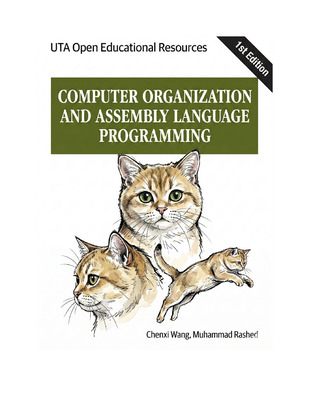
Computer Organization and Assembly Language Programming
Chenxi Wang PhD and Muhammad Rashed PhD
Computer Organization and Assembly Language Programming is an open textbook written for CSE 2312 students at The University of Texas at Arlington and for anyone who wants to see clearly how high-level code becomes machine operations. The book takes the position that assembly is not a historical curiosity but a working tool: it is where system programming, embedded development, performance tuning, and real debugging skill begin.
Across sixteen chapters, this textbook builds from number systems and base conversion through ALU operations, status flags, and shift operations, then into ARMv7 assembly syntax, the load and store architecture, endianness, addressing modes, branch instructions, the procedure calling mechanism, and the stack. Later chapters cover strings and integer arrays in memory, floating point encoding and decoding, packed and unpacked data alignment, VFP instructions, the three stage pipeline and clock cycle analysis, and finally cache hierarchy and memory virtualization.
This resource was created through the UTA CARES Grant Program and published by Mavs Open Press, which means it is free to read, adapt, and reuse under the license of CC BY-NC-SA. It was shaped by feedback from fellow CSE 2312 instructors, graduate teaching assistants, and the students who piloted it, and refined toward one goal: making this subject easier to follow, and more fun to study.
-
![Desert Dichotomies: Climatic Imaginaries of the Arid+[Ant]arctic by Amanda Aman](https://mavmatrix.uta.edu/oer_mavsopenpress2/1001/thumbnail.jpg "Desert Dichotomies: Climatic Imaginaries of the Arid+[Ant]arctic by Amanda Aman")
Desert Dichotomies: Climatic Imaginaries of the Arid+[Ant]arctic
Amanda Aman
Desert Dichotomies is a research-based architecture design studio that examines the impacts of climate change across arid and polar desert environments, revealing unexpected parallels between landscapes often understood as environmental opposites. Focusing on Antarctica, Arctic Alaska and the Sonoran Desert, the project investigates how climate change, resource extraction and human systems of control are transforming ecological processes, water systems and cultural landscapes. While arid deserts face increasing drought and water scarcity, polar deserts are experiencing accelerated warming, ice loss, permafrost thaw and flooding. Despite these contrasting conditions, both regions exhibit similar consequences, including declining water quality, biodiversity loss, infrastructural vulnerability and disproportionate impacts on Indigenous communities.
Through case studies of Antarctic marine ecosystems, the Colville and Kobuk River basins of Arctic Alaska and the Colorado and Gila River systems within the Sonoran Desert, students explored the relationships between hydrology, ecology, land sovereignty and human occupation. Utilizing archival research, geospatial analysis, open-source mapping tools and environmental data, the studio produced the Arid + [Ant]Arctic Atlas, a comparative framework that visualizes climate change across multiple scales and contexts. Students translated this research into speculative visualizations and imagined futures through architectural representation and generative AI tools. By positioning mapping and storytelling as instruments of environmental advocacy, the project advances a design pedagogy grounded in climate literacy, environmental justice and the visualization of more equitable and resilient futures.
-
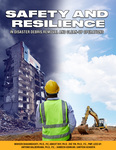
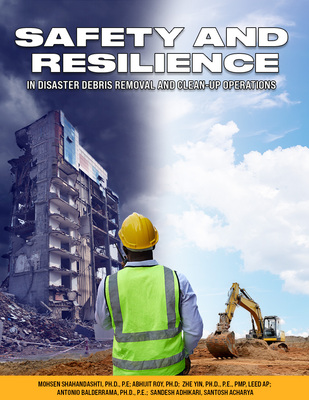
Safety and Resilience in Disaster Debris Removal and Clean-Up Operations: A Field and Training Guide for Resilience Workers in Disaster Debris Removal and Cleanup
Mohsen Shahandashti, Ph.D, P.E.; Abhijit Roy, Ph.D; Zhe Yin, Ph.D, P.E., PMP, LEED AP; Antonio Balderrama, Ph.D, P.E.; Sandesh Adhikari; and Santosh Acharya
A practical safety guide for the people who clear debris after disasters, and for the trainers who prepare them. Built for crews of every experience level--from seasoned operators to first-time volunteers--it teaches how to read a damaged site, recognize hidden and shifting hazards, work safely around heavy equipment and hazardous materials, and make sound decisions under pressure. Every chapter pairs clear guidance with a one-page field job aid, facilitator notes for trainers, and a real-world scenario, all grounded in OSHA, FEMA, EPA, and NIOSH guidance.
Safety and Resilience in Disaster Debris Removal and Clean-Up Operations Copyright © 2026 by Mohsen Shahandashti, Ph. D., P.E.; Abhijit Roy, Ph.D. is licensed under a Creative Commons Attribution-NonCommercial-ShareAlike 4.0 International License, except where otherwise noted.
Unless otherwise noted, all images in the book are individually licensed. Please see image credits for additional information.
OER materials produced through funding from the UTA CARES Grant Program, and final reports from creators, preserved and shared openly. Each book can also be accessed as a chapter-by-chapter interactive ebook through Mavs Open Press Pressbooks: https://uta.pressbooks.pub/.
Printing is not supported at the primary Gallery Thumbnail page. Please first navigate to a specific Image before printing.